Origins
The story of St Saviour's begins in 1625, when Nathan Walworth — born at Ringley Fold in 1572 and Steward to the Earl of Pembroke — donated a chapel to the community. It was an act of remarkable generosity, and the building that followed would shape the spiritual life of this corner of Lancashire for centuries to come. The chapel's inscription, still preserved today, reads: 'This Chappell was erected at ye cost and charges of Nathan Walworthe some to Ellis Walworthe An° Do 1625.'
The path to consecration was not straightforward. The Bishop of Chester refused to consecrate the building until money for its maintenance was guaranteed, and the dispute dragged on for nearly ten years. At one point, Walworth threatened to pull the place down entirely, sell the timber and stones, and give the money to the poor — declaring that the land would remain God's either way. His patience eventually prevailed, and the chapel was consecrated in December 1634.
The name St Saviour's Chapel was chosen by John Bridgeman, Bishop of Chester, who signed the consecration deed on 1st June 1635. It was among the first chapels built and endowed in Lancashire by private benevolence after the Reformation. Nathan never married and died in 1640/1; his portrait, painted in his capacity as steward of Baynard's Castle in London — the seat of the Pembrokes — hangs in the north aisle to this day.
Early years
In 1640, Nathan Walworth's will recorded that he had recently built a schoolhouse near the chapel — an early sign of the community role the church would play beyond Sunday worship. A vestry was added to the chapel in 1726, recorded by a plaque now on Barry's surviving tower. That schoolhouse eventually fell down in 1798 and was replaced by a new one erected by public subscription, which stood between the Horse Shoe Inn and the canal until it was demolished when a new school opened in 1872.
A portrait of Nathan Walworth was kept in the vestry of Ringley church for many years, and was engraved as the frontispiece of a published collection of his correspondence in the nineteenth century — a testament to the lasting esteem in which the founder was held by the community he served.
The second church (1826–27)
By 1826, the original chapel had been replaced by a second church, built almost on the same site and consecrated on 6th August 1827 — the Feast of Our Lord's Transfiguration. Its architect was Charles Barry, then just thirty-one years old, working under the commission of the local trustees. Barry would go on to design the Houses of Parliament. He also designed All Saints in Stand — one of several churches funded from the £1,000,000 thank offering voted by the Government following the victory at Waterloo.
The tower from Barry's 1826 church still stands today, isolated beside the road, as a Grade II listed building in its own right. It is in three stages, with clock faces on each side of the top stage and an embattled parapet with a pinnacle at each corner. Set into its west wall is a single stone salvaged from the original 1625 chapel, bearing the inscription: 'Nathan Walworth Builded Mee. Anno Do 1625.' Plaques above the door record the vestry addition of 1726 and the church's rebuilding in 1826.
The present church (1850–54)
By the mid-nineteenth century, Barry's church had become too small for the growing congregation. It was demolished in 1850 — all except the tower, which was left standing — and the foundation stone of the new church was laid by R. S. Sowler, Esq., as senior churchwarden.
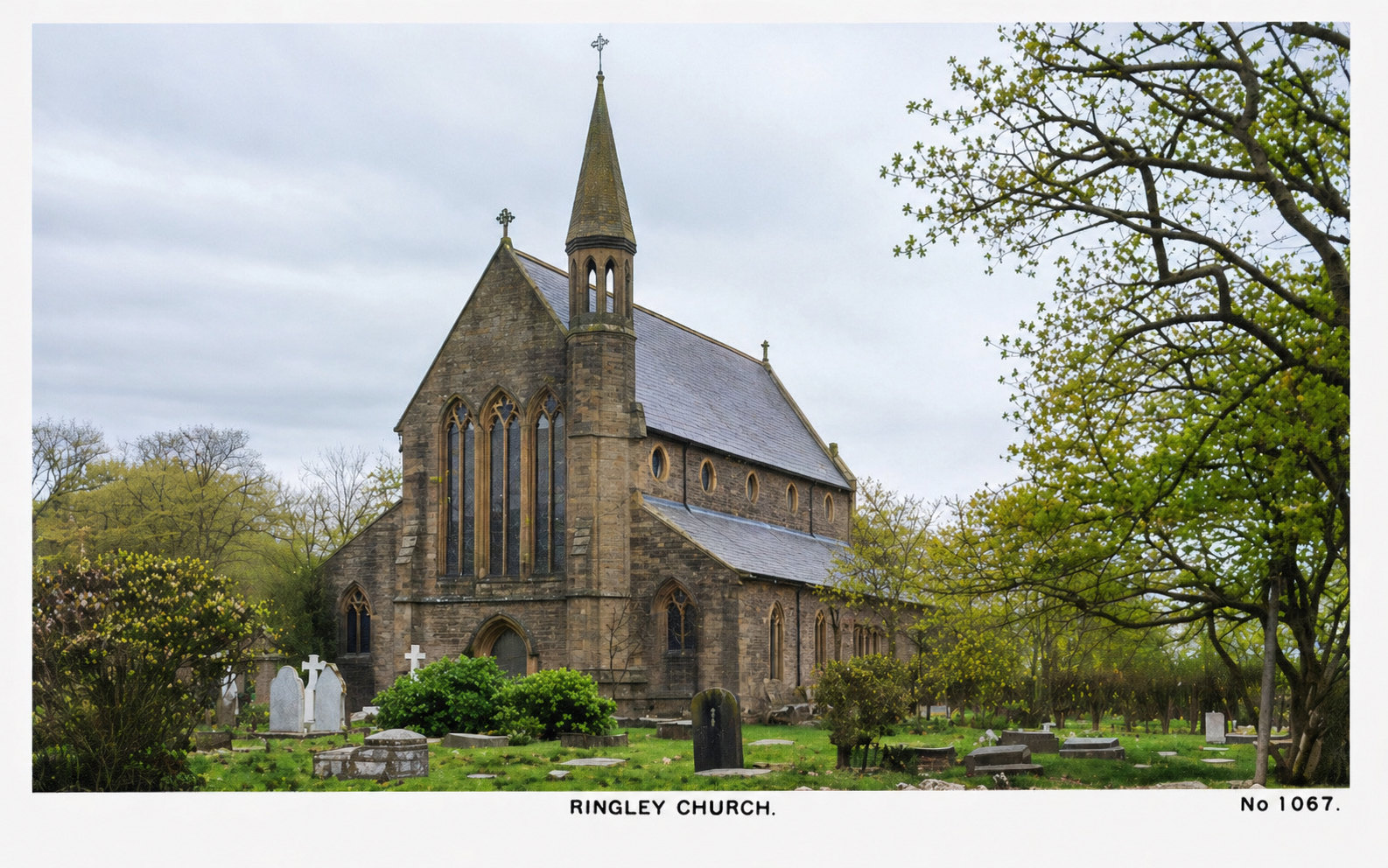
The new church was designed by the Lancaster architects Sharpe and Paley — at this date principally a design by E. G. Paley, who also superintended the construction. It was consecrated on 10th June 1854 by Dr James Prince Lee, the Bishop of Manchester, and is capable of accommodating around 560 worshippers. The incumbent at the time of consecration was James Radcliffe Lyon M.A. The collection on the day raised £62. A grant of £200 was provided by the Church Building Commissioners towards the total cost of approximately £2,500, with a further £500 contributed by the 13th Earl of Derby.
The building is in the Early English Gothic style of the 13th century, constructed in mellow stone with ashlar dressings and a stone slate roof. Its plan includes a five-bay nave with a clerestory, north and south aisles, a north porch, and a chancel with a south vestry. The nave is 75 feet 6 inches long, the chancel 30 feet 6 inches. At the southwest corner stands an octagonal turret with lancet bell openings and a spire. The nave aisles have plate tracery windows of two trefoil-headed lights under quatrefoils, and the west end features three tall pointed two-light windows. The east window is a triplet, glazed with painted glass carried over from the ancient chapel.
Several fittings were carried over from the earlier church, including the chancel rails in rococo style and a communion table in the north chapel dated 1654. The stained glass on the north side of the chancel dates from the 17th century. The chancel was comprehensively refitted in the late 19th century with a High Victorian decorative scheme, at which point the original Carolean altar — previously the High altar — was moved to the Lady chapel. Later additions include an alabaster and mosaic reredos in nine panels from 1883, a rood beam with figures from 1925, and a chapel altar with canopy from 1921.
Parish records
St Saviour's has kept registers of baptisms, marriages and burials since at least 1719, making them among the most significant genealogical sources for families with roots in Ringley, Stoneclough, Outwood, Prestolee and the surrounding townships.
Researching family history?
Baptism, marriage and burial registers from 1719 onwards are held on microfilm at Manchester Archives and Local Studies, with no booking required for microfilm access. Some registers are also available online via the Manchester Archives collections at Ancestry.
A full list of registers and microfilm references is available on the Manchester City Council Archives directory. The Lancashire OnLine Parish Clerks Project holds transcribed records for the parish at lan-opc.org.uk.
A growing parish
Nathan Walworth builds the original chapel at Ringley at his own cost, one of the first chapels endowed by private benevolence in Lancashire after the Reformation.
Chapel consecrated by the Bishop of Chester after a decade-long dispute over maintenance endowment. Named St Saviour's Chapel by Bishop John Bridgeman.
A vestry is added to the original chapel — recorded on a plaque now visible on Barry's surviving tower.
Original chapel replaced by a new church designed by Charles Barry, consecrated on the Feast of the Transfiguration, 6th August 1827.
Barry's church demolished (save the tower) and replaced with the present building, designed by Sharpe and Paley and consecrated 10th June 1854. Seats approximately 560.
The chapelry was made into a full parish by an Order in Council on 20th October, during the incumbency of the Revd James Henry Street. The parish at that time covered roughly four miles by three.
The Wilkinsons organ installed, dedicated to the glory of God in thanksgiving for the reign of Queen Victoria.
The tower was repaired, raised two feet, and a new clock inserted to mark the jubilee of the third church. The tower had an official reopening in 1907.
The mission church of St Aidan was opened and dedicated in May, to serve the rapidly growing settlement of Outwood.
The choir vestry was added to St Saviour's. An altar with a canopy was installed in the northwest chapel.
St Mary's — a former army hut — was consecrated by the Bishop and opened on Lady Day to serve the hamlet of Bottom o'th'Fields in Outwood.
Incumbency of the Revd David Matthews, who put a stop to the old village custom of ducking Ringley's elected 'Mayor' in the canal — a tradition that had seen the chosen individual carried round the district's public houses before a noisy finale at the water's edge. The custom had been stopped once before by the Revd Street, but reintroduced in the 1920s.
St Aidan's was destroyed by fire. The land was subsequently sold for new housing.
The parish of St Saviour's, Ringley was united with that of Holy Trinity, Prestolee, forming the Parish of Stoneclough. Emmanuel Mission — founded by members of St Saviour's following a dispute in the early twentieth century — remains a separate organisation nearby, though the two congregations are on friendly terms.
Major repair work carried out: roof repairs, a new heating system, stonework and glass renewal, and underpinning and stabilisation of the Chancel. Refurbishment of the choir vestry completed in 2002.
The Mayor-making tradition was revived briefly as more of a community event — but without the ducking.
St Mary's closed following the demise of the colliery at Outwood and the demolition of Bottom o'th'Fields. Tebay's Bowling Green Inn, once used as a Sunday School after closing time on Sunday afternoons, had shut in 1957.
Memorials & monuments
In the south aisle are mural monuments to Matthew Fletcher, owner of the Wet Earth Colliery, who died on 21st August 1808 aged 78, and to his nephew Ellis Fletcher, who died on 26th April 1834 aged 69. The Fletchers owned Clifton Colliery among others, and Matthew Fletcher played a significant role in the construction of the Manchester, Bolton and Bury Canal. Coal and passenger boats were running by 1796, before the canal was even completed. Ellis's widow Mary (died 1836) and their sons John (1836) and Ellis (1854) are also commemorated.
Inside the church stand two wooden memorial plaques — one for the First World War, one for the Second — recording the names of local servicemen and women from the parish who gave their lives. The Commonwealth War Graves Commission records ten identified casualties buried in the churchyard: six from the First World War, and four from the Second including two airmen, a soldier, and a Royal Naval Volunteer Reserve officer.
A dedicated memorial page records all the names from both plaques at St Saviour's and Holy Trinity, with full transcriptions and historical context. If you have a personal connection to any of the names, the parish would be glad to hear from you — please get in touch.
The clergy of Ringley
A plaque inside St Saviour's records the succession of clergy who have served the parish since its foundation. Erected in 1954 to mark the centenary of the consecration of the parish church, it lists the incumbents from William Seddon M.A. in 1627 through to Anthony Roache B.A. in 2002 — nearly four centuries of continuous ministry.
The list reflects the changing patterns of ministry over time: the disruptions of the Civil War period, the long tenures of the eighteenth century, and the more frequent changes of the modern era. Among those named is Talbot Dilworth-Harrison M.A. (1917–1927), who erected the First World War memorial in memory of his brother Douglas Roy Dilworth-Harrison, who fell on Easter Eve 1918.
Incumbents of Ringley
Erected by parishioners & friends to mark the centenary of the consecration of the Parish Church at Ringley, 1854–29th June 1954
The current Rector of the Parish of Stoneclough is Fr Stephen, serving both St Saviour's, Ringley and Holy Trinity, Prestolee.
Features of interest
St Saviour's interior rewards a careful look. Several of its fittings and furnishings carry histories stretching back centuries, and together they tell the story of the community that has worshipped here.
Portrait of Nathan Walworth
North aisle
A portrait of the church's founder, painted in his capacity as steward of Baynard's Castle in London — the seat of the Earls of Pembroke. Nathan never married and died in 1640/1. The Pembrokes were a rich and powerful family, favourites at court until the Civil War, and related to the poets Sir Philip Sidney and George Herbert.
The Original Altar
East end of north aisle
Dating from 1625, this is the Jacobean altar from the original chapel, consecrated in 1634. After nearly seventy years of disuse it was restored, and the chapel was furnished at the charges of the mothers of this parish in 1919. An inscription on the wall records its history.
The Chained Bible
North aisle
Expository Notes on the New Testament by W. Burkitt M.A., Rector of Dedham, Essex. Dates from 1729.
The Rood Beam
Chancel arch
Erected in 1925 as part of the Tercentenary celebrations marking three hundred years of worship at Ringley.
The Square Windows
Chancel
Three stained glass armorial windows, said to have been formerly the east window of the original chapel, now set into the lights of the chancel.
The Reredos
East wall
An alabaster and mosaic reredos in nine panels, erected in 1883.
The Organ
Chancel
A three-manual pneumatic organ by Wilkinsons of Kendal, with 21 speaking stops, six couplers and seven composition pedals. Its inscription reads: 'To the Glory of GOD in commemoration of and thanksgiving for the reign of Victoria, Queen of England and Empress of India, December 12th, 1903.'
The Fletcher Memorials
South aisle
Mural monuments to Matthew Fletcher (died 21st August 1808, aged 78) and his nephew Ellis Fletcher (died 26th April 1834, aged 69). The Fletchers owned Clifton Colliery among others; Matthew played a major part in getting the Manchester, Bolton and Bury Canal built, with boats running by 1796. Ellis's widow Mary and their sons John and Ellis are also commemorated.
The Crosse Memorials
Interior
Commemorating the Crosse family of Kearsley Hall, who were related to William Hulme (died 1691), founder of the educational trust. Ann Cross, who died in 1814, left an endowment to provide annual payments to ten infirm, old and indigent persons legally settled in the township of Kearsley.
Royal, Derby & Pembroke Arms
West wall and over the north door
Installed at the direction of Nathan Walworth himself. His original unpacking instructions survive and give a flavour of the man: 'First, observe that the syde wch is chalked is the upper syde... the greatest care of all that no help be wantinge whereby in the lifting them up, for want of help anythinge be broken, brused or disfigured.'